Artificial intelligence is becoming part of children’s everyday lives. Kids use AI chatbots to ask questions, get homework help, create stories, explore new topics, and have conversations.
But as AI becomes more accessible, parents face an important question:
How can you make sure the AI content your child sees is appropriate for their age?
This is where an AI content filter for kids can help.
AI content filtering is designed to identify and reduce exposure to inappropriate, harmful, or age-inappropriate content during a child’s interaction with artificial intelligence. But not all filters work the same way, and a single filter is not always enough.
In this guide, we’ll explain what an AI content filter for kids is, how AI content filtering works, what parents should look for, and why content filtering should be part of a broader AI safety strategy.
What Is an AI Content Filter for Kids?
An AI content filter for kids is a safety system designed to help prevent children from being exposed to inappropriate or potentially harmful content when using artificial intelligence.
Depending on the system, content filtering may analyze:
- What the child writes to the AI
- What the AI generates in response
- The meaning and context of a conversation
- Topics that may be inappropriate for the child’s age
- Repeated or potentially concerning conversation patterns
The goal is not simply to block individual words.
A more effective AI safety system should consider context, intent, and the child’s age.
For example, the word “violence” could appear in a history question, a school assignment, or a genuinely inappropriate request. A basic keyword filter may treat all of these situations the same way.
Context-aware AI content filtering can help distinguish between these situations and respond more appropriately.
Why Do Kids Need AI Content Filters?
Many general-purpose AI systems are designed for a broad audience.
Children, however, have different developmental needs and may not always understand:
- Which questions are appropriate
- What information should remain private
- Whether an AI response is accurate
- When a conversation becomes inappropriate
- How AI safety restrictions can be bypassed
Children are also naturally curious.
They may ask questions without understanding where the conversation could lead.
An AI content filter can provide an additional layer of protection by helping identify potentially inappropriate content before or during the interaction.
However, content filtering should not replace parental guidance. It should work alongside family rules, education, and appropriate parental supervision.
What Types of Content Should an AI Filter for Kids Help Detect?
A good AI content filter for children should help identify several categories of potentially concerning content.
Inappropriate Sexual Content
Children should not be exposed to sexual or adult-oriented content that is inappropriate for their age.
AI safety systems should help prevent both inappropriate requests and inappropriate AI responses.
Violence and Disturbing Content
Some questions may lead to graphic or disturbing responses.
Age-appropriate filtering can help reduce unnecessary exposure while still allowing educational discussions when appropriate.
Dangerous Activities
Children may ask AI for instructions without understanding potential risks.
AI safety filters can help identify conversations involving potentially dangerous activities and respond with safer guidance.
Harmful or Abusive Language
Filtering can help detect inappropriate language, bullying, harassment, or other harmful interactions.
Privacy Risks
Children may accidentally share personal information during an AI conversation.
A child-focused AI safety system can help identify situations where a child may be sharing information that should remain private.
Content safety is only one part of protecting children online. Parents should also understand AI privacy for kids and how personal information can be exposed during AI conversations.
Attempts to Bypass AI Safety Rules
Some users attempt to make AI systems ignore their safety restrictions through techniques often called jailbreaks.
Children may encounter these prompts online or receive them from friends.
A stronger AI safety system should consider both inappropriate content and attempts to bypass the rules designed to prevent that content.
How Does AI Content Filtering Work?
Different systems use different technologies, but a stronger approach often involves multiple safety layers.
1. Input Filtering
Input filtering analyzes what the child sends to the AI.
The system can identify potentially inappropriate, dangerous, or sensitive requests before they continue through the conversation.
2. Context and Intent Analysis
Simple keyword filtering is often not enough.
AI systems can analyze the meaning and context of a request to better understand what the child is actually asking.
This helps reduce situations where harmless educational questions are incorrectly blocked.
3. Output Filtering
Filtering should also examine what the AI sends back.
Even if a child’s question appears harmless, an AI response may contain information that is too mature or inappropriate for the child’s age.
Output filtering provides an additional safety layer.
4. Age-Appropriate Response Controls
Children of different ages should not necessarily receive the same type of answer.
An effective child-focused AI system can adjust:
- Vocabulary
- Explanation depth
- Tone
- Topic handling
- Safety boundaries
Age-aware controls can help make AI conversations more appropriate for the individual child.
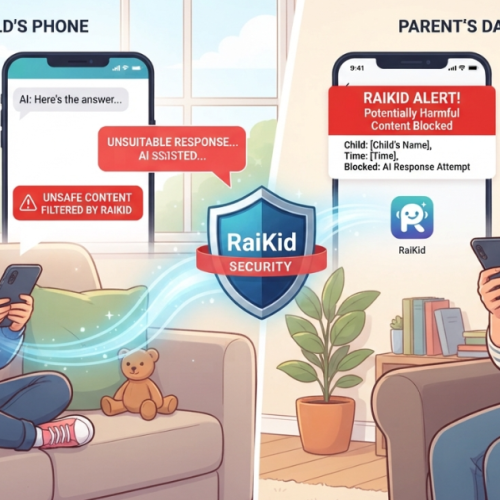
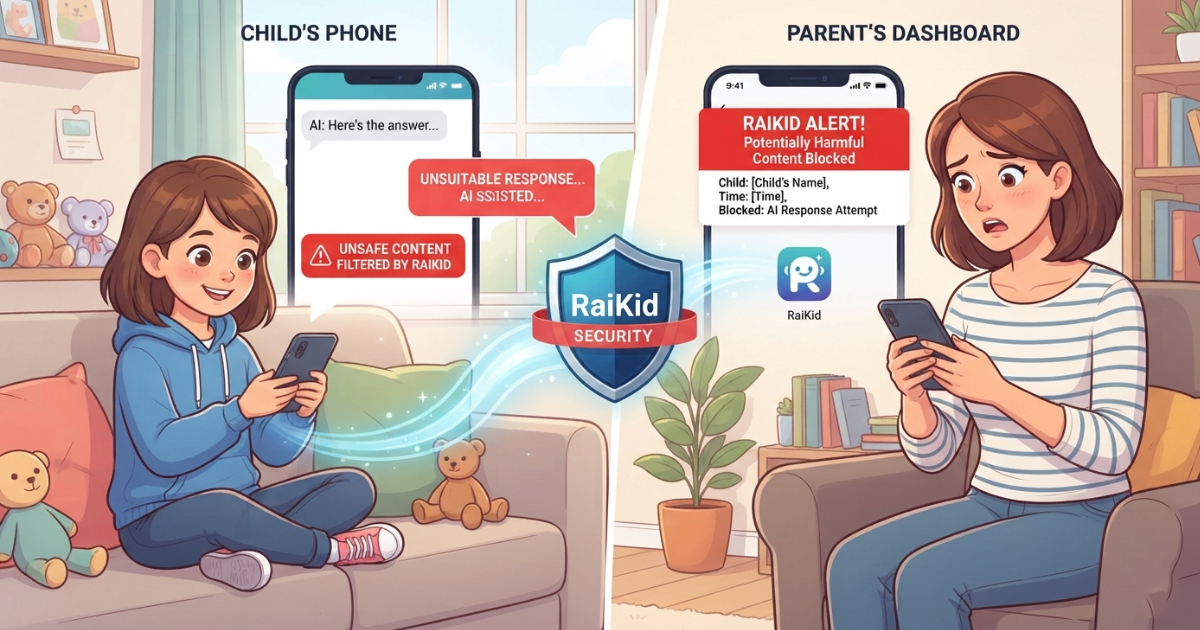
5. Safety Alerts and Monitoring
Some systems can also identify conversations that may require parental attention.
Instead of requiring parents to manually review every interaction, alerts can help highlight potentially concerning situations.
For parents who want greater visibility, you can also learn how to monitor kids’ AI conversations safely.
Why a Single AI Content Filter May Not Be Enough
One of the biggest mistakes parents can make is assuming that a single filter makes an AI completely safe.
No safety technology can guarantee that every inappropriate response will be prevented.
AI safety should therefore use multiple layers.
A stronger approach may combine:
Content filtering + age-appropriate responses + parental controls + conversation monitoring + family rules.
Together, these layers can help reduce risks and give parents more visibility into how their children use AI.
To understand the broader picture, read our guide on safe AI for kids.
AI Content Filtering vs Traditional Parental Controls
Traditional parental control apps are useful for managing a child’s digital activity.
They may help parents:
- Manage screen time
- Block websites
- Restrict applications
- Control device access
- Monitor general activity
However, traditional parental controls may not always understand what is happening inside an AI conversation.
For example, they may show that a child used an AI application for 30 minutes, but not identify whether the conversation involved potentially inappropriate content.
This is where AI-specific content filtering and AI conversation monitoring can provide an additional layer of protection.
Content filtering is only one layer of protection. An AI parental control app can combine content safety with parental visibility, alerts, and age-appropriate AI experiences.
If you’re looking for broader device protection as well, you can compare the best parental control apps for Android.
Can AI Content Filters Understand Context?
Basic content filters often rely on blocked words or predefined categories.
However, AI conversations are more complex.
The same word can have different meanings depending on the conversation.
For example, a child asking about war for a history project is different from a child requesting graphic or disturbing content.
This is why context-aware filtering can be important.
A more advanced AI content safety system can evaluate the broader meaning and intent of a conversation instead of relying only on individual words.
However, no system is perfect, which is why multiple safety layers and parental guidance remain important.
How Parents Can Improve AI Safety Beyond Content Filters
AI content filters are useful, but parents can take additional steps.
Set Clear AI Rules
Talk to your child about when and how AI can be used.
You may want to establish rules around:
- Personal information
- Sensitive topics
- Homework
- Screen time
- AI applications that are allowed
- Asking a parent for help when something feels uncomfortable
For more guidance, see our guide to AI rules for kids.
Choose Age-Appropriate AI Tools
Not every AI chatbot is designed with children in mind.
Parents should consider whether a tool provides:
- Age-appropriate responses
- Safety filtering
- Privacy protections
- Parental settings
- Clear safety policies
Talk About AI Privacy
Children should understand that they should not share sensitive personal information with an AI.
Teach your child not to share information such as:
- Full name
- Home address
- School details
- Phone number
- Passwords
- Family financial information
Keep Communication Open
Children should feel comfortable telling a parent if an AI says something confusing, disturbing, or inappropriate.
Technology works best when it is combined with communication.
How RaiKid Uses AI Safety Layers to Protect Children
RaiKid is designed to provide children with a safer and more age-appropriate AI experience.
Instead of relying on a single safety control, RaiKid uses multiple layers designed to help reduce exposure to inappropriate content and identify potentially concerning interactions.
Child Input Protection
RaiKid can help identify inappropriate or unsafe requests before they continue through the AI conversation.
AI Response Safety
AI responses can also be evaluated to help reduce the risk of inappropriate content reaching the child.
Age-Appropriate Conversations
RaiKid can adapt AI responses based on the child’s age to provide explanations and interactions that are more appropriate for their developmental stage.
Parental Visibility
Parents can have visibility into their child’s AI activity and potentially concerning interactions.
Real-Time Safety Alerts
When an interaction requires attention, RaiKid can help notify parents.
Custom AI Rules
Families can establish additional boundaries based on their own values and preferences.
This combination of filtering, age awareness, parental visibility, and customizable rules creates a broader safety approach than relying on content filtering alone.
Content filtering works best alongside clear family boundaries and AI rules for kids.
Frequently Asked Questions
What is an AI content filter for kids?
An AI content filter for kids is a safety system designed to help identify and reduce children’s exposure to inappropriate, harmful, or age-inappropriate content when using artificial intelligence.
Do AI content filters block everything inappropriate?
No system can guarantee that every inappropriate piece of content will be identified or blocked. For this reason, content filtering should be combined with other safety measures such as age-appropriate AI, parental supervision, and family rules.
Can an AI content filter protect children from AI chatbots?
AI content filtering can provide an additional layer of protection by analyzing requests and responses. The level of protection depends on the technology and safety systems used by the AI platform.
Are traditional parental controls enough for AI safety?
Traditional parental controls can be useful for managing devices, apps, websites, and screen time. However, AI-specific safety systems may provide additional protection by focusing on what happens inside AI interactions.
Can AI filters detect privacy risks?
Some AI safety systems can help identify situations where a child may be sharing sensitive personal information. Parents should still teach children what information should remain private.
Final Thoughts
AI can provide valuable learning and creative opportunities for children.
But children need a different level of protection than adults.
An AI content filter for kids can help reduce exposure to inappropriate or potentially harmful content, but filtering alone should not be considered a complete solution.
The strongest approach combines:
- AI content filtering
- Age-appropriate responses
- Privacy protection
- Parental visibility
- Safety alerts
- Clear family rules
- Open communication
By combining these layers, parents can help children explore the benefits of AI while reducing unnecessary risks.
RaiKid is designed to help families create a safer AI experience for children through multi-layered safety, age-appropriate AI responses, parental visibility, real-time alerts, and customizable AI rules.
Discover how RaiKid helps make AI safer for kids
About RaiKid
RaiKid is a child-focused AI safety platform designed to help families give children a safer and more age-appropriate AI experience. RaiKid combines AI safety filtering, age-aware conversations, parental visibility, customizable rules, and real-time safety alerts.